
RESEARCH


Mechanisms of Contact-dependent Secretion Systems
Our lab focuses on the type 4 secretion system (T4SS) and type 6 secretion system (T6SS). Both T4SS and T6SS are employed by a wide variety of bacteria to deliver biomolecules into neighboring cells. The T4SS notably mediates horizontal gene transfer between bacterial cells through conjugative transfer of DNA, while the T6SS is used by bacteria to deliver toxic effectors into adjacent bacterial or eukaryotic cells. We are interested in how these systems mediate interactions within bacterial populations.
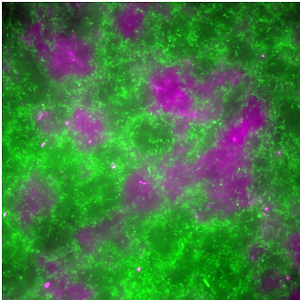
Visualization of Bacterial Competition
Using fluorescence microscopy, we can visualize inter-bacterial competition. Bacteria species or strains with distinct T4SS or T6SS behaviors can be differentially labeled and tracked in real time. Specific gene modifications in these bacteria can than be directly correlated with changed in larger population dynamics and bacterial community organization.
Crosstalk between quorum sensing and contact-dependent interbacterial interactions
Vibrio cholerae uses quorum sensing (QS) signals to regulate the transition between growth as multi-cellular aggregates and growth as planktonic individuals. This aggregative behavior has a direct impact on the efficacy of contact-dependent secretion systems like T4SS and T6SS. Our lab is currently exploring how the dynamics of these interacting systems play out during bacterial community formation.